
Hopewell-Centre Monthly Meeting
Centre Quaker Meetinghouse
Historical Easement
by Mary Lou and Roger Koontz
As Hopewell Centre Friends Meeting continues its efforts to obtain an
historical easement, I'd like to share some of the reasons why Roger and
I believe having the historical easement is so important.
On a personal level, Centre Meetinghouse has been a part of my life for
as long as I can remember. I began my spiritual life there with my
parents from the time I was old enough to attend meeting. It was a place
of peace and solace as I grew from childhood to adulthood. Roger became
a convinced Quaker after our marriage, and our daughters, Susan and
Cathy, grew up in this meeting. Centre Meetinghouse is an integral part
of my family and many other families.
Our goal is to preserve the Meetinghouse for future generations. In
today's world having a place of peace and love is more important than
ever. The original partition in the interior (as described in the
history set out below) is still in place, although not presently useable.
It is my and Roger's hope to have the partition restored to working
order.
The Meetinghouse has been a part of Winchester in its present form since
1872, and has served as a place of worship for Quakers and non-Quakers
alike. Even today, although Hopewell Centre Meeting gathers there on a
regular basis only on the fourth first day of each month, it is used as a
place for spiritual meeting every day, but Saturday, by AA and members of
the Baihi Faith. I've been told that when an AA member attending a
meeting there is in particular distress, he or she often goes quietly
into the worship area and finds solace in the sacred silence.
By obtaining a historical easement for the Meetinghouse, we can be
assured that it will never be used for any purpose other than as a
religious center. It is as important today and will be in the future as
it was in the long-ago past. Below is a wonderful poem by John Greenleaf
Whittier that beautifully expresses the essence of the solace and peace
found in our Quaker meetinghouses and our Quaker meetings for worship and
the sacred silence.
And so I find it well to come
For deeper rest to this still room
For here the habit of the soul
Feels less the outer world's control
The strength of mutual purpose pleads
More earnestly our common needs;
And from the stillness multiplied
By these still forms on either side,
The world that time and sense have known
Falls off and leaves us God alone.
-John Greenleaf Whittier
Set out below is a short history of the Winchester Centre Quaker Meeting
which was taken in toto from a pamphlet, titled "Welcome to Winchester
Centre Quaker Meeting," written by a Friend or Friends prior to the
merger of the two meetings.
This is the third building used by Friends in Winchester. The original
site of Centre Meeting was about a mile Southwest of Winchester, near
Willow Lawn about 1777. In 1817, Sara Zane, a sister of General Isaac
Zane of the Marlboro Iron Works, gave ground in Winchester, which
consisted of the entire 600 block on the West side of South Washington
Street, to the Friends Centre Meeting and steps were taken to erect a
Meeting House. The
Meeting House was used until the Civil War. A committee was formed to
investigate the cause of the destruction of the Meeting House. The
report states: "We find that it (the Meeting
House) was first occupied as a hospital for the Southern army in the
summer of 1861. Meetings were held there afterwards until about the 12th
day of the 3rd month of 1862, on which day, Bank's army arrived in
Winchester. The military authorities demanded the key and took
possession of the Meeting House. Friends never used it afterwards. In
1862-1863 under General Melroy's command, the balance of the woodwork was
destroyed by the troops. The walls remained standing until about 1863,
then fell down. After the fall of the building, the remaining materials
were used or destroyed by a portion of the citizens of the town."
At the time, it was the opinion that the new Meeting House should be
located in the central part of town. A committee was formed and
appointed to purchase land on which to build. On the 8th day of the 2nd
month of 1872, the first Monthly Meeting was held at the new Winchester
Centre Meeting House located on the corner of North Washington Street and
West Piccadilly. The cost of building the meetinghouse was about $2,500
to $3,000.
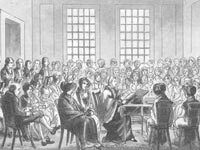
The Meeting House is a long narrow building containing one room. In the
center there is a folding wall which divides the building into two rooms.
The paneled wall can be raised or
lowered by a crank located above the present ceiling. Along the east
wall is a balcony. On the west side, the floor is raised to provide two
levels. In the front are two entrances and the rear contains two exits.
The women would enter on one side and the men on the other. During the
meeting for worship the folding wall would be raised. At the time of the
business meeting the wall was lowered so women could have their own
business meeting. Necessary messages were passed between the two
meetings through a sliding opening in the partition. The practice of
separate meetings contributed to the ability of early Quaker women to
conduct business meetings. This practice was discontinued in the late
1800s.
Until January of 1970, Winchester Centre Meeting was a preparative
meeting under Hopewell. From 1970 until 1999, Winchester was an
independent Monthly Meeting, at
which time Centre Meeting and Hopewell Meeting merged to create Hopewell
Centre Meeting.
Our worship service (unprogrammed) is based in the expectancy that in
silent, united search for truth, God will be present.
|